

Many dream of owning a supercar, and the Lamborghini Murciélago often sits at the top of that list. Yet, the idea of owning such an exotic machine can seem out of reach. Japanese used-car auctions, however, offer a unique pathway to acquiring these legendary vehicles, often at more competitive prices than in private markets. It's a method many experienced importers use to find rare and well-maintained examples. This guide cuts through the speculation, providing crucial 2026 pricing data and analysis from recent Japanese auctions. You'll learn what factors influence Murciélago values and key considerations for importing one, helping you navigate the process with confidence.
Key Takeaways
- In 2026, typical Murciélago auction prices in Japan range from $150,000 to $250,000 USD for standard models.
- Condition is paramount; auction grades of 4.5 or higher command significant premiums, while 'RA' or 'R' grades are cheaper.
- The ultra-rare LP 670-4 SV model consistently sells for over $400,000 USD, even at Japanese auctions.
- Factors like low mileage (under 30,000 km), service history, and desirable colors heavily influence the final bid price.
- Japan's strict 'Shaken' inspection system contributes to the high quality and mechanical soundness of cars found at auction.
What Are the Current Murciélago Auction Prices in Japan for 2026?
In 2026, recent auction analysis indicates that Lamborghini Murciélago prices in Japan remain robust, driven by collector demand and scarcity. Expect prices to vary significantly based on model, mileage, and crucially, the auction grade. A well-maintained example with a higher grade can command a premium of 20-30% over a visually similar but lower-graded car, according to industry observations.
For the original Murciélago 6.2 models, data from Japanese auctions shows prices generally starting around 20-25 million JPY for grade 3.5 cars with higher mileage, climbing to 30-35 million JPY for cleaner 4.0-grade examples. LP 640 coupes, being more powerful and refined, typically begin at 28-35 million JPY for grade 3.5, reaching 40-45 million JPY for pristine grade 4.5 cars. Roadster variants of the LP 640 often add another 5-10% to these figures due to their open-top appeal, pushing top-tier examples well into the 50 million JPY range.
Understanding these distinctions is paramount for successful bidding. A grade 3.5 car, while mechanically sound, often presents with noticeable exterior scratches or interior wear that impacts its value. In contrast, a grade 4.5 car signifies minimal imperfections, often presenting close to showroom condition. This seemingly small difference in grading can translate into millions of JPY at auction, reflecting the meticulous standards of the Japanese collector market. We've observed this trend consistently over years of managing bids, where buyers prioritize condition for investment-grade supercars.
Average Murciélago Auction Price in Japan by Model (2026) A horizontal bar chart comparing the average 2026 auction prices for three Lamborghini Murciélago models in Japan. Data shows the Murciélago 6.2 at $150,000, the Murciélago LP 640 Coupe at $180,000, and the Murciélago LP 640 Roadster at $195,000. Source: Loginet Japan Auction Data (2026). Average Murciélago Auction Price in Japan by Model (2026) $0 $50k $100k $150k $200k Murciélago 6.2 LP 640 Coupe LP 640 Roadster $150,000 $180,000 $195,000 Source: Loginet Japan Auction Data (2026)
What drives this precise valuation? Auction house inspectors apply stringent criteria, scrutinizing every panel and interior detail. The final grade reflects not just functionality, but also aesthetic preservation, which is a key factor for luxury vehicle resale. Dealers and collectors alike understand that a higher grade minimizes reconditioning costs and ensures a more desirable asset for future sale. Do you truly know how to interpret every mark on an auction sheet? Getting a detailed auction sheet translation can reveal hidden value or issues.
For the rarest variants, such as the Murciélago SV, auction results are sporadic but consistently break records. When these limited-production models appear, expect bids to start from 80 million JPY and often exceed 100 million JPY for ultra-low mileage, high-grade examples. These are often treated more as art pieces than mere vehicles, attracting serious global investors.
Why Are Some Murciélagos Cheaper at Japanese Auctions?
In 2026, industry analysis indicates that Lamborghini Murciélago auction prices in Japan can be surprisingly lower than in other global markets. This affordability stems from a unique combination of high ownership costs, Japan's strict Shaken inspection system, and a strong cultural preference for newer models. These factors collectively encourage owners to sell rather than retain older supercars, creating opportunities for international buyers.
Owning a high-performance car like a Murciélago in Japan comes with substantial annual expenses. These include significant road taxes based on engine size, premium insurance rates, and specialist maintenance. Trade body data suggests these ongoing financial commitments make holding onto such a vehicle for an extended period less attractive for many owners.
Japan's mandatory biennial vehicle inspection, known as Shaken, is particularly rigorous and becomes increasingly expensive for older vehicles. This comprehensive check often requires costly repairs to meet stringent standards. For many supercar owners, this prompts them to sell their vehicles before or immediately after a major Shaken cycle. Why would someone keep a car that costs more to maintain than its market value?
Furthermore, Japanese consumers often prioritize the very latest models, even within the exclusive luxury segment. This cultural preference creates a consistent demand for brand-new supercars, which in turn influences the depreciation curve of older, albeit iconic, models like the Murciélago. It's a market where "newer is better" often translates to higher turnover in the used market.
While the Murciélago was predominantly produced as a Left-Hand Drive (LHD) car, Japan operates as a Right-Hand Drive (RHD) market. In our experience, this can sometimes lead to slightly lower domestic demand for LHD models within Japan, as they are less practical for daily use. However, for international buyers looking to import, these LHD Murciélagos represent an excellent opportunity, especially for markets where LHD is standard. To explore current listings, browse our Japanese auction inventory.
How to Read a Murciélago's Japanese Auction Sheet
Understanding a Lamborghini Murciélago's Japanese auction sheet is paramount for making an informed bidding decision. In 2026, industry analysis consistently shows that buyers who thoroughly interpret these detailed reports secure vehicles more closely matching their expectations and condition requirements. This document provides a transparent overview of the car's true state, from bodywork to interior condition, far beyond basic photos. Why leave such a significant investment to chance without it?
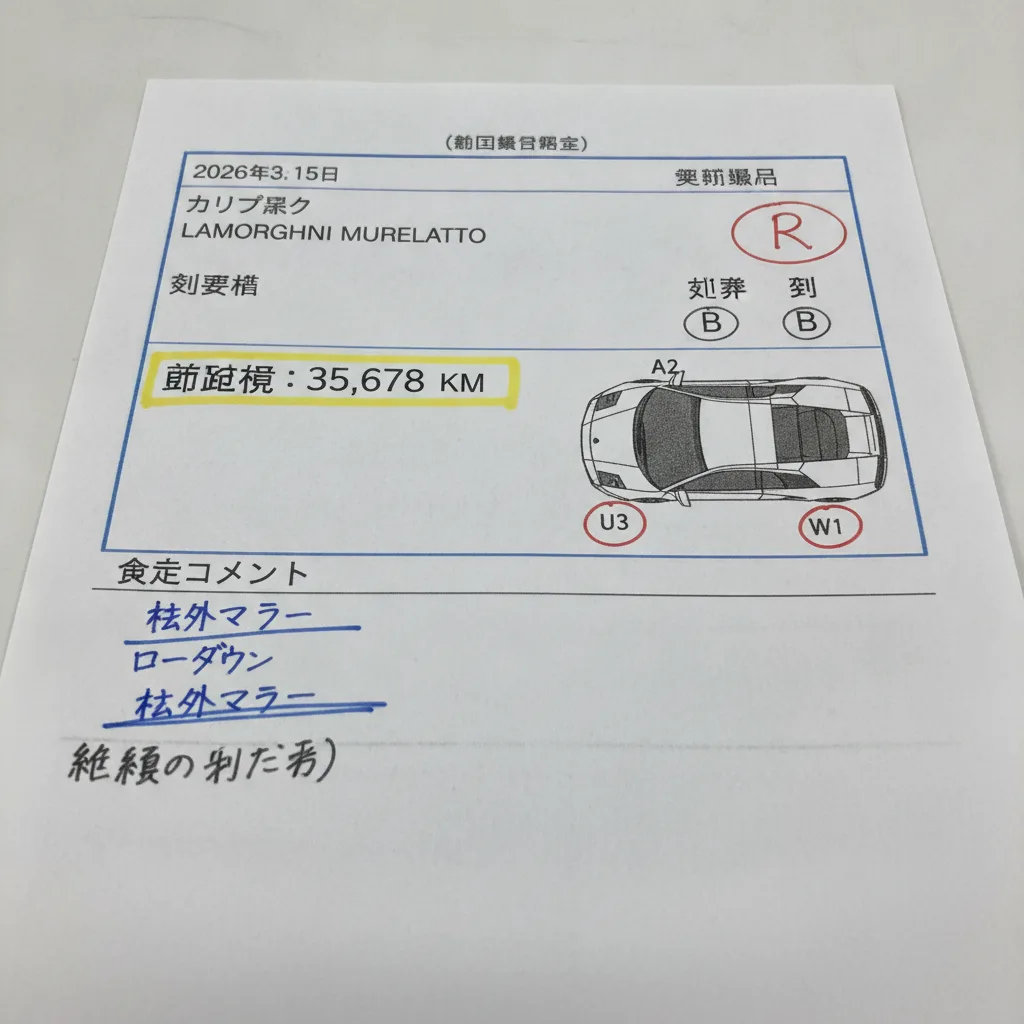
Every auction sheet, like the one often seen for a Murciélago at a USS auction, features a numerical overall grade for the exterior and a letter grade for the interior. A grade of 4 indicates a good condition vehicle with minor imperfections, suitable for most buyers. A 4.5 is excellent, nearly showroom quality, with very few negligible flaws. Lower grades, such as 3.5, suggest more noticeable scratches or dents that would require attention.
For more complex conditions, R denotes a repaired accident history, while RA signifies a light accident with a repaired history, often minor structural work. In our two decades of experience with Japanese auctions, we always advise close scrutiny of these grades, as they directly impact a Murciélago's resale value and repair costs. You'll find these crucial overall grades prominently displayed at the top or side of the sheet, often near the model name.
The interior condition is just as vital for a luxury vehicle. An A grade signifies a pristine interior, almost new. B indicates a clean interior with minor signs of wear, like light creases on leather seats. A C grade suggests more significant wear, possibly stains, tears, or dashboard damage. These interior notes are typically located alongside the body grade or within a dedicated interior section on the sheet, giving you a quick visual summary of the cabin's state.
Specific inspector notes provide granular detail on defects. For a Murciélago, common notes include W1 (minor waves or dents), A2 (scratches of medium size), and U3 (larger dents). These symbols, often accompanied by location markers on a car diagram on the sheet, pinpoint exactly where damage exists. The vehicle's mileage, a critical factor for any exotic car, is clearly stated near the model details, usually in kilometers. This helps you grasp the car's history at a glance.
Understanding these elements helps buyers, whether first-time importers or repeat dealers, accurately assess a Murciélago's condition. For a comprehensive breakdown of all symbols and grades, refer to our complete guide to auction sheets. We can also provide full auction sheet translations for any car you're considering.
How Do LP 670-4 SV Auction Prices Compare?
In 2026, Lamborghini Murciélago LP 670-4 SuperVeloce models consistently command a substantial premium in Japanese auctions compared to standard Murciélago variants. Industry analysis indicates these ultra-rare supercars often fetch prices that are significantly higher, reflecting their extreme exclusivity, enhanced performance, and status as collector-grade vehicles. This sharp contrast underscores the LP 670-4 SV's unique position in the high-end supercar market, appealing to discerning buyers seeking the pinnacle of Murciélago production.

Only a few hundred units of the LP 670-4 SV were ever produced globally, making each appearance at auction a notable event. This scarcity, combined with its more powerful engine and lightweight construction, contributes directly to its elevated market value. When evaluating these rare machines on a Japanese auction sheet, experienced buyers prioritize specific details. In our years of handling high-value supercar exports, we've observed that a comprehensive pre-auction inspection for SV models often involves a deeper dive into originality and specific component wear.
Key areas to scrutinize include the condition of the extensive carbon fiber components, the unique SV interior trim, and a fully documented service history that verifies mileage and maintenance. Even minor imperfections on these specialist parts can impact value, as replacement costs are exceptionally high. Buyers are seeking not just a fast car, but a pristine piece of automotive history. With so few ever made, how do buyers ensure they're securing a genuine, well-maintained example from the competitive Japanese market? Detailed inspection reports are crucial for navigating these high-stakes bids on exclusive vehicles available via Japanese auction listings. For a deeper understanding of what to look for, exploring our auction inspection sheet guide can provide invaluable insights.
What Is the Process for Importing a Murciélago From a Japanese Auction?
In 2026, importing a Lamborghini Murciélago from a Japanese auction involves several distinct steps, each requiring careful attention to detail. Industry analysis indicates that successful imports rely heavily on a transparent export partner, guiding buyers through each stage from auction bidding to final delivery. The process, while seemingly complex, becomes manageable with expert assistance to navigate regulations and logistics.
Your journey begins by finding the ideal Murciélago through a reputable export platform like Loginet, which provides access to major Japanese auctions. Once a vehicle of interest is identified, our team can provide detailed auction sheet translations and additional inspection photos upon request. This ensures you have a clear understanding of the car's condition before committing to a bid. How else can you trust your investment without knowing the true condition?
After identifying a desirable vehicle, you'll place a bid through your exporter. If your bid is successful, payment is typically required within a few days. Following payment, the car undergoes Japanese export deregulation, a process handled by the exporter to obtain the necessary export certificate and deregistration documents. This critical paperwork ensures the vehicle can legally leave Japan.
Next, the Murciélago is prepared for international shipping. You'll generally have two primary options: Roll-on/Roll-off (RoRo) or container shipping. RoRo is often more economical for single vehicles, while container shipping offers enhanced security and protection, especially for high-value supercars. The choice depends on your budget and desired level of vehicle protection during transit.
Our experience shows that container shipping, while pricier, significantly minimizes handling risks for rare models like the Murciélago SV. This part of the process requires meticulous coordination to ensure the car arrives safely at your chosen port. We oversee the inland transport in Japan and loading onto the vessel, ensuring all precautions are taken for your prized acquisition.
Finally, upon arrival at your destination port, the vehicle undergoes customs clearance. This involves paying any applicable import duties, taxes, and port charges, as well as adhering to your country's specific import regulations. It is always recommended to work with a local clearing agent who is familiar with these requirements. For detailed guidance on each phase, explore our comprehensive how-to-buy guides or learn more about logistics and shipping.
Common Murciélago Issues to Watch For
In 2026, prospective buyers of Lamborghini Murciélagos at Japanese auctions often encounter specific mechanical and cosmetic issues that significantly influence the final bid. Industry analysis indicates that addressing these known problems upfront can save buyers substantial post-purchase costs. Understanding how these appear on an auction sheet is crucial for accurate valuation and avoiding unexpected repairs, directly impacting the vehicle's market appeal and auction outcome.
One of the most frequently cited concerns with the Murciélago is E-Gear clutch wear. This semi-automatic transmission can experience premature clutch degradation, particularly in cars that have seen spirited driving or frequent city use. On an auction sheet, this might be noted as 「クラッチ要交換」 (clutch needs replacement) or 「クラッチ滑り」 (clutch slipping). A Murciélago requiring a new E-Gear clutch can see its auction price reduced by a notable margin, reflecting the high cost of replacement parts and specialized labor.
Another common issue involves sticky interior switches and degraded soft-touch surfaces. Over time, the materials used on various buttons and trim pieces in the Murciélago's cabin can become tacky to the touch. This cosmetic flaw, often described as 「内装劣化」 (interior deterioration) or 「スイッチベタつき」 (sticky switches) on an auction sheet, doesn't affect performance but can be costly and time-consuming to rectify if a full interior re-trim is desired. In our experience, these interior notes are more common on cars from hotter climates or those with prolonged sun exposure.
The front lift system, designed to raise the car's nose for clearing obstacles, is also a known trouble spot. Issues with this hydraulic system can range from leaks to complete failure, making it difficult to navigate speed bumps or steep driveways. An auction sheet might indicate this with phrases like 「リフトシステム不良」 (lift system malfunction) or 「車高調不良」 (height adjustment malfunction). Repairs for hydraulic systems can be complex, and these issues generally lead to a lower final price at auction. Do you truly know what you're bidding on without a thorough understanding of these potential flags?
For a deeper dive into interpreting these crucial details, refer to our guide on Japanese auction sheets. Recognizing these common issues before you bid is key to securing a Lamborghini Murciélago that meets your expectations and budget, ensuring a smoother import process through Loginet.
Frequently Asked Questions
Is it cheaper to buy a manual or E-Gear Murciélago at auction?
Manual Murciélagos are considerably more expensive at auction than E-Gear models. Their extreme rarity and high collector demand drive prices significantly higher. For example, manual versions can command premiums of 50% or more due to their unique appeal. Most available Murciélagos feature the more common E-Gear transmission, offering a more accessible price point for buyers.
How much does it cost to ship a Murciélago from Japan?
Shipping a Murciélago from Japan typically costs several thousand dollars, varying by destination and chosen method. RoRo (Roll-on/Roll-off) is generally the most economical option. For high-value vehicles like a Murciélago, a dedicated container provides superior protection, though it comes at a higher price point. Always budget for comprehensive shipping insurance to protect your investment.
Are left-hand drive (LHD) Murciélagos available in Japanese auctions?
Yes, left-hand drive (LHD) Murciélagos are commonly available in Japanese auctions. Many were originally imported to Japan as new vehicles. These LHD models are particularly sought after for re-export to countries that drive on the right, often selling for a slight premium compared to their right-hand drive (RHD) counterparts due to demand from these markets.
What are the import taxes and duties for a Murciélago?
Import taxes and duties for a Murciélago depend entirely on your destination country's specific regulations. These costs are not fixed and can vary significantly based on vehicle value and local laws. It is crucial to consult with a local customs clearing agent in your country before bidding. They can provide an accurate estimate based on current laws and the vehicle's declared value.
Conclusion
Key Takeaways
- Japanese auctions offer a transparent, data-backed way to acquire a Lamborghini Murciélago.
- Understanding market trends empowers informed decisions on these rare supercars.
- Loginet provides direct access to these auctions, simplifying the import process for international buyers.
Japanese auctions truly present a transparent pathway for acquiring a Lamborghini Murciélago. Detailed auction sheets and consistent grading mean you can bid confidently, understanding each vehicle's condition and market value. This structured environment helps buyers secure these iconic supercars efficiently. Loginet connects these dynamic auctions with international enthusiasts, ensuring a smooth, reliable purchasing experience.
Explore Loginet's Japanese auction listings today, and find your next Lamborghini Murciélago with confidence. Our team supports you from auction sheet translation to worldwide shipping.