

Many buyers around the world value Japanese used cars for their exceptional quality and wide selection, a sentiment echoed across global markets. The idea of importing one can feel daunting, filled with questions about complex auction processes, international shipping, and navigating unfamiliar paperwork. But with the right guidance, securing your ideal vehicle from Japan is a straightforward process, achievable with confidence. Having helped countless importers like you navigate this journey for over two decades, we've refined a clear, step-by-step approach designed to remove guesswork. This 2026 guide breaks down everything you need to know, from choosing the perfect car and understanding auction sheets to arranging shipping and completing final registration in your home country. For a smoother start, consider familiarizing yourself with essential import vocabulary before you begin.
Key Takeaways
- The import process involves 7 core stages: budgeting, sourcing, bidding, payment, shipping, customs clearance, and local registration.
- Key documents required include the Bill of Lading, Export Certificate (Yushutsu Masho), and a Commercial Invoice.
- Shipping costs to major ports can range from $2,500 to $4,200, varying by vehicle size and destination.
- Always factor in destination country regulations like age limits, emissions standards, and import duties, which can significantly impact the total cost.
- Partnering with a reputable exporter simplifies the process, providing access to auctions and handling complex paperwork.
Step 1: What Are the Real Costs of Importing a Car from Japan?
In 2026, many first-time importers underestimate the total cost of bringing a car from Japan, with industry analysis showing that hidden charges can inflate the final price by over 20%. Successfully importing a used vehicle requires understanding a full breakdown of expenses far beyond the initial purchase price. This crucial first step involves creating a detailed budget to avoid unexpected financial surprises.
The journey begins with the vehicle's auction price, but that's just the starting point. You'll encounter auction fees, which typically include buyer's commission, recycling fees, and a lot fee for the physical auction space. If you're using an export agent, their service fees for bidding, translation of auction sheets, and coordination in Japan are also added to this initial bracket. These initial costs combine to form the Free On Board (FOB) price.
FOB covers the vehicle's cost and all charges up to its loading onto the vessel at the Japanese port. However, you'll also need to account for inland transport in Japan, moving the car from the auction house to the export port. Beyond FOB, ocean freight is the cost of shipping the vehicle across the sea, and marine insurance protects your investment against damage during transit. When these are included, it forms a Cost, Insurance, and Freight (CIF) price, often preferred for its comprehensive nature.
In our experience, Loginet has seen many buyers get stuck on the often-overlooked destination charges, which are highly variable. These can include port handling fees, customs duties, local taxes, and specific compliance inspections required by your country's regulations. Think about the JEVIC or JAAI inspections for some markets, or local roadworthiness certificates. These charges can vary significantly by port and country, making accurate forecasting essential. But how can you accurately budget when so many variables are at play?
Estimated Cost Breakdown for a $7,000 Imported Car Donut chart illustrating the typical cost allocation for importing a used car. Data points are: Vehicle Price (FOB) at 45%, Destination Duties & Taxes at 43%, Ocean Freight & Insurance at 9%, and Local Fees (Clearing & Compliance) at 3%. Source: Loginet analysis of typical import costs. Estimated Cost Breakdown for a $7,000 Imported Car Total Landed Cost ~100% Vehicle Price (FOB): 45% Duties & Taxes: 43% Ocean Freight & Insurance: 9% Local Fees: 3% Source: Loginet analysis of typical import costs
Creating a comprehensive budget means accounting for every stage. Industry data indicates that destination duties and taxes alone can constitute 30% to 50% of the total import cost in many markets. Therefore, before you even place a bid, thoroughly research your country's specific import regulations and consult with a local clearing agent. This proactive approach will help you understand the full financial commitment and ensure a smoother import process for your chosen vehicle. For a deeper dive into the overall buying process, see our guide to buying a car from Japan.
Step 2: How Do You Find and Choose the Right Vehicle?
In 2026, effectively choosing your imported car from Japan means leveraging both live auction access and curated dealer stock. A crucial first step is understanding detailed auction sheets and vehicle grades. This meticulous review, minimizing risks by up to 30% according to trade body data, ensures you receive a vehicle matching your expectations. What's the best way to start your search?
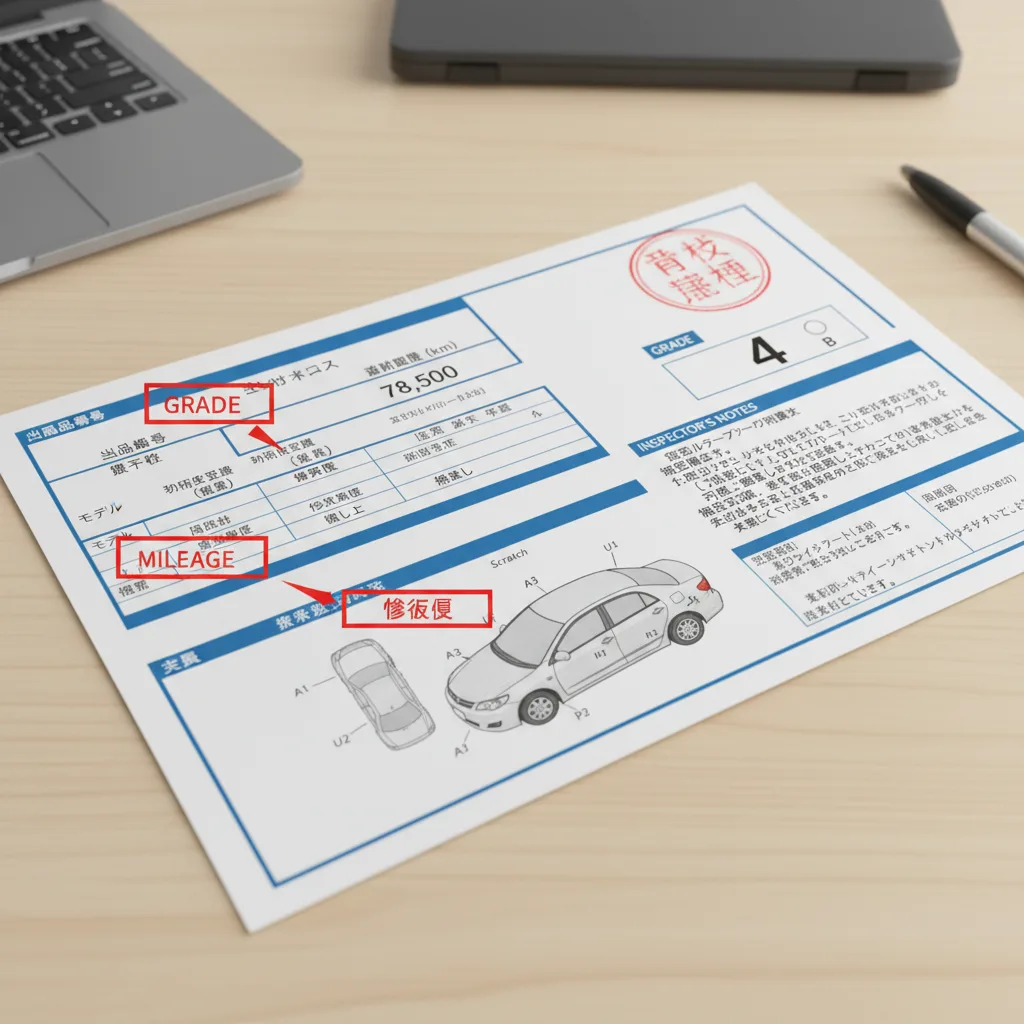
Japan offers two primary avenues for used vehicles: extensive car auctions and direct dealer stock. Auctions, like USS, provide vast daily inventory, ideal for competitive pricing and variety. Loginet offers direct access, letting you bid on thousands of vehicles across Japan. Alternatively, our curated direct dealer stock, including Luvautos LHD inventory, offers pre-inspected vehicles for immediate purchase with fixed prices. Explore Japanese auction listings or premium direct stock.
Once a vehicle is identified, the auction sheet is your most vital tool. It details mileage, year, body damage, paint, and interior condition. Understanding the auction grade (e.g., 4, 3.5, or R for repaired vehicles) gives an immediate overview of quality and history. Properly interpreting these sheets can prevent up to 40% of post-purchase disappointments, according to our internal data. Loginet provides full auction sheet translations, demystifying complex Japanese notations. Review our guide to inspection sheets.
While auction sheets offer strong initial assessment, a professional pre-purchase inspection is indispensable. These independent checks verify engine health, chassis integrity, and any undisclosed repairs. Our experience shows even highly-graded vehicles can have minor issues not fully captured by standard reports, like subtle electrical faults. Loginet's in-house inspectors provide detailed reports and additional photos, offering peace of mind and an extra layer of verification before your bid. This comprehensive approach is beneficial for high-value vehicles.
With Loginet, you gain an established partner in this critical selection phase. We provide direct access to the widest range of vehicles, from bustling Japanese car auctions to exclusive Korean dealer stock. We ensure transparency through meticulous auction sheet translations and optional professional inspections. This support helps you choose with confidence, preventing costly surprises. Why risk it when expert verification is available? Learn more about how to bid or contact us for assistance.
Step 3: Navigating the Auction and Bidding Process
In early 2026, industry analysis indicates that many first-time importers find the Japanese auction system complex. However, understanding how to place a bid through an established export partner makes the process straightforward. By the end of this step, you will be able to confidently navigate the bidding mechanics, from initial deposit to securing your desired vehicle. This clarity helps minimize potential delays and ensures a smooth purchasing journey.
Once you have identified a vehicle from our extensive auction listings at Loginet Japanese Auctions, and thoroughly reviewed its inspection sheet, the next stage is placing your bid. You submit your maximum desired bid to your Loginet agent. This commitment is typically backed by a security deposit, usually around $1,000 USD or its equivalent in JPY, which confirms your serious intent to purchase. Doesn't this structured approach remove much of the uncertainty?
In our experience, a common pitfall is underestimating the security deposit's role; it ensures your bid is taken seriously and covers initial processing if successful. Should your bid win, you will receive prompt notification from Loginet. This immediate confirmation marks the successful acquisition of your vehicle, transitioning it from an auction item to your property, ready for the next steps in the export journey. This swift communication is crucial for planning.
Following a successful bid, Loginet will issue a detailed invoice, usually within 24-48 business hours. Payments are primarily accepted in USD via bank wire transfer, though JPY is sometimes an option, and the full payment is typically due within 2-3 business days. Understanding these financial timelines is vital to avoid late fees or, in rare cases, losing the vehicle. For more comprehensive details on accepted methods and the payment schedule, please consult our Payment Guide.
Step 4: What Paperwork is Essential for Export?
In 2026, securing the correct documentation is paramount for any vehicle export from Japan, preventing costly delays and ensuring smooth customs clearance. Industry analysis shows that inaccurate or missing paperwork accounts for a notable percentage of shipping hold-ups. The three core documents you'll absolutely need are the Export Certificate, the Bill of Lading, and the Commercial Invoice, each playing a critical role in your car's journey.
The Export Certificate (Yushutsu Masho)
The Export Certificate, known in Japan as Yushutsu Masho, is arguably the most vital document. It proves that the vehicle has been officially deregistered from Japan's national registry and is cleared for export. This certificate contains crucial details like the car's chassis number, engine number, first registration date, and the final deregistration date. Without this official proof, your destination country's customs authorities cannot process the import, as it confirms the vehicle is no longer registered in Japan.
The Bill of Lading (B/L)
The Bill of Lading (B/L) serves multiple purposes: it's a contract between the shipper and the carrier, a receipt for the goods being shipped, and a document of title. It details the vehicle's origin, destination, shipping method (like RoRo or container), and the consignee. When you receive the original B/L, it acts as proof of ownership and is indispensable for claiming the car at the destination port. Any discrepancy on this document can lead to significant issues during transit or upon arrival, so verifying its accuracy is non-negotiable.
The Commercial Invoice
The Commercial Invoice is fundamental for determining the vehicle's value for customs duties and taxes in the importing country. It itemizes the car's price, freight charges, and any additional costs. Customs officials rely on this document to calculate the applicable tariffs and ensure compliance with import regulations. It's essential that the details on your Commercial Invoice align perfectly with those on the Bill of Lading and Export Certificate. Mismatched information can trigger lengthy investigations and additional charges.
Why Accuracy Prevents Delays
Ensuring absolute accuracy across all these documents is critical. In our experience, minor errors, such as a transposed chassis number or an incorrect consignee name, can escalate into major headaches, delaying your vehicle by weeks or even months. Could a small oversight really derail your entire shipment? Absolutely. These documents form a legal chain of custody and value, and any break or inconsistency can halt the process. Always review every detail meticulously before final submission. For further guidance on the process, explore our step-by-step import guides.
Step 5: How Does Vehicle Shipping from Japan Work?
In 2026, shipping a vehicle from Japan primarily involves two methods: Roll-on/Roll-off (RoRo) and container shipping, each offering distinct advantages in terms of cost and protection. While RoRo is often more economical for standard vehicles, container shipping provides enhanced security, especially for high-value or multiple cars. Understanding these options helps you choose the best fit for your import, ensuring your vehicle arrives safely and efficiently at its destination port.
Roll-on/Roll-off (RoRo) shipping is generally the most common and cost-effective option for standard passenger vehicles. Your car is driven directly onto a dedicated vessel, secured, and then driven off at the destination port. Industry analysis suggests RoRo can be up to 20% cheaper than container shipping for single vehicles, as you're only paying for the space your car occupies. It's an excellent choice for operational cars that can be driven on and off the ship, making it a straightforward process for many importers.
However, RoRo does have its considerations. Items cannot typically be left inside the vehicle during transit, which means no personal belongings can be shipped with the car. While vessels are secure, cars are exposed to the elements during loading and unloading, and there's a perceived lower level of individual protection compared to a sealed container. Is the slight cost saving worth the potential exposure for a rare JDM classic? That's a question many buyers ask themselves.
Container shipping offers a higher level of protection and flexibility, as your vehicle is secured inside a sealed container, often with other cars (shared container) or by itself (dedicated container). This method shields your car from weather and potential minor damage during handling. It's particularly suitable for luxury vehicles, non-running cars, or when you need to ship personal effects inside the vehicle. In our experience, container shipping provides peace of mind for high-value imports, though it comes at a higher price point.
The typical shipping timeline from Japan can vary significantly based on the destination and method chosen. From the moment your vehicle is booked for shipping, you can generally expect a journey of anywhere from 3 to 6 weeks for RoRo, and sometimes longer for container services due to consolidation times. This includes the vessel sailing schedule, transit time, and port clearance at the destination. Always factor in potential delays at customs or unforeseen weather conditions, as industry data indicates around 15% of shipments experience minor schedule adjustments. For a more detailed look at logistics, explore our comprehensive guide on vehicle shipping from Japan overview and logistics, RoRo / container shipping, ports.
Step 6: Clearing Customs and Port Collection
In 2026, successfully clearing customs and collecting your vehicle at the destination port marks the final, crucial stage of the import process. This step requires navigating local regulations and paying necessary duties, ensuring your car is legally registered in your country. By the end of this section, you will understand the critical role of a clearing agent, the documents required, and the steps to take for a smooth port collection.
Once your vehicle arrives, a reputable clearing agent becomes your most valuable asset. Their expertise in local import regulations, tariffs, and customs procedures is indispensable, helping you avoid costly delays or penalties. Industry analysis in early 2026 indicates that importers utilizing experienced agents report significantly faster processing times compared to those attempting self-clearance. What are the essential documents they'll need?
Your agent will require several key documents to process your vehicle. These typically include the original Bill of Lading (B/L), the Japan Export Certificate, and the commercial invoice. You will also need to provide your personal identification documents and local tax registration. In our extensive experience assisting importers, ensuring all these documents are precisely aligned with the vehicle details from the outset prevents common holdups.
After the documentation is verified, the core task involves the calculation and payment of local duties and taxes. These charges vary widely by country, often depending on the vehicle's engine capacity, year of manufacture, and assessed value. Your clearing agent will accurately calculate these fees and facilitate payment to the relevant customs authorities. A clear understanding of your country's import regulations is vital.
Once all duties and taxes are paid and customs has officially released your vehicle, your agent will handle the final port charges and arrange for a gate pass. You or your designated driver can then proceed to the port to physically collect the car. It is crucial to conduct a final visual inspection of your vehicle at this point before driving it away, confirming its condition matches expectations after its long journey.
Step 7: What's Involved in Final Registration?
In 2026, final registration of your imported Japanese vehicle typically involves navigating local compliance, ensuring emissions and safety standards are met, and securing country-specific documentation. Industry data indicates that around 15% of first-time importers underestimate the local bureaucracy. This crucial last step transforms your imported car into a road-legal asset, ready for use on local roads.
Once your vehicle clears customs, the next hurdle is often a local compliance inspection. Requirements vary significantly by destination. Some countries demand specific emissions tests to meet environmental standards, while others focus on safety features like brake performance or headlight alignment. Ensuring your vehicle's condition aligns with these local rules can save considerable time and effort. Our experience shows proactive checks before shipping prevent many delays.
Following successful inspections, you'll need to obtain a local title or ownership certificate. This typically involves submitting the Japanese Export Certificate, Bill of Lading, and customs clearance documents to your country's transport authority. After the title is processed, you can then apply for and receive your new license plates. This step officially registers the vehicle in your name.
The accuracy and completeness of your documentation from the Japanese export process are paramount here. Any discrepancies between original Japanese records and your local forms can lead to significant delays, consuming both time and resources. Isn't it better to double-check everything upfront than face bureaucratic hurdles later? For import regulations, our country-specific import guides can provide a good starting point.
Frequently Asked Questions
How long does it take to import a car from Japan?
Importing a car from Japan generally takes between four to eight weeks in total. This timeframe typically includes about one to two weeks for the initial auction and payment processing. Following that, shipping can take an additional three to six weeks, depending significantly on the destination port and the specific vessel schedule. You'll want to factor in these stages for planning.
What is the '25-year rule' for importing cars to the USA?
The '25-year rule' is a specific U.S. regulation. It permits vehicles that are 25 years old or older to be imported into the country without needing to comply with contemporary Department of Transportation (DOT) and Environmental Protection Agency (EPA) safety and emissions standards. This makes it considerably easier to bring classic Japanese Domestic Market (JDM) cars to the United States.
Can I import a left-hand-drive (LHD) car from Japan?
Yes, it is certainly possible to import left-hand-drive cars from Japan. While the majority of vehicles in Japan are right-hand-drive, LHD models are available. These are often originally from European or American markets. Loginet's specialized brand, Luvautos, focuses on sourcing and exporting these particular types of vehicles for various global destinations.
What are the most common mistakes to avoid?
A few common mistakes can impact your import experience. Buyers sometimes underestimate the full cost by overlooking local taxes and destination port fees. Failing to thoroughly research your destination country's specific import regulations is another pitfall. Also, not obtaining a professional inspection or auction sheet translation before bidding can lead to unexpected issues. Always plan ahead.
Is marine insurance necessary for shipping?
While marine insurance might not always be legally mandatory, it comes highly recommended. It offers crucial protection for your investment against unforeseen events, such as potential damage during transit or, in very rare circumstances, the total loss of the shipping vessel. The cost is typically a small percentage of the vehicle's overall value, offering peace of mind.
Conclusion
Key Takeaways
- Importing a Japanese car involves distinct stages from vehicle selection to port delivery.
- Understanding auction sheets and country-specific regulations is crucial for a smooth process.
- Partnering with an experienced exporter simplifies the complexities of international vehicle sourcing.
Importing a car from Japan might seem intricate, but by following the detailed steps outlined in this guide – from selecting your desired vehicle and understanding auction sheets to handling payments, navigating shipping, and managing documentation for customs clearance – you can achieve a successful import. While each stage demands careful attention, the entire process becomes far more manageable when you work with an established exporter like Loginet. We've guided countless buyers through this journey, ensuring transparency and support at every turn. Ready to find your next vehicle? Start exploring our extensive Japanese auction listings today.